

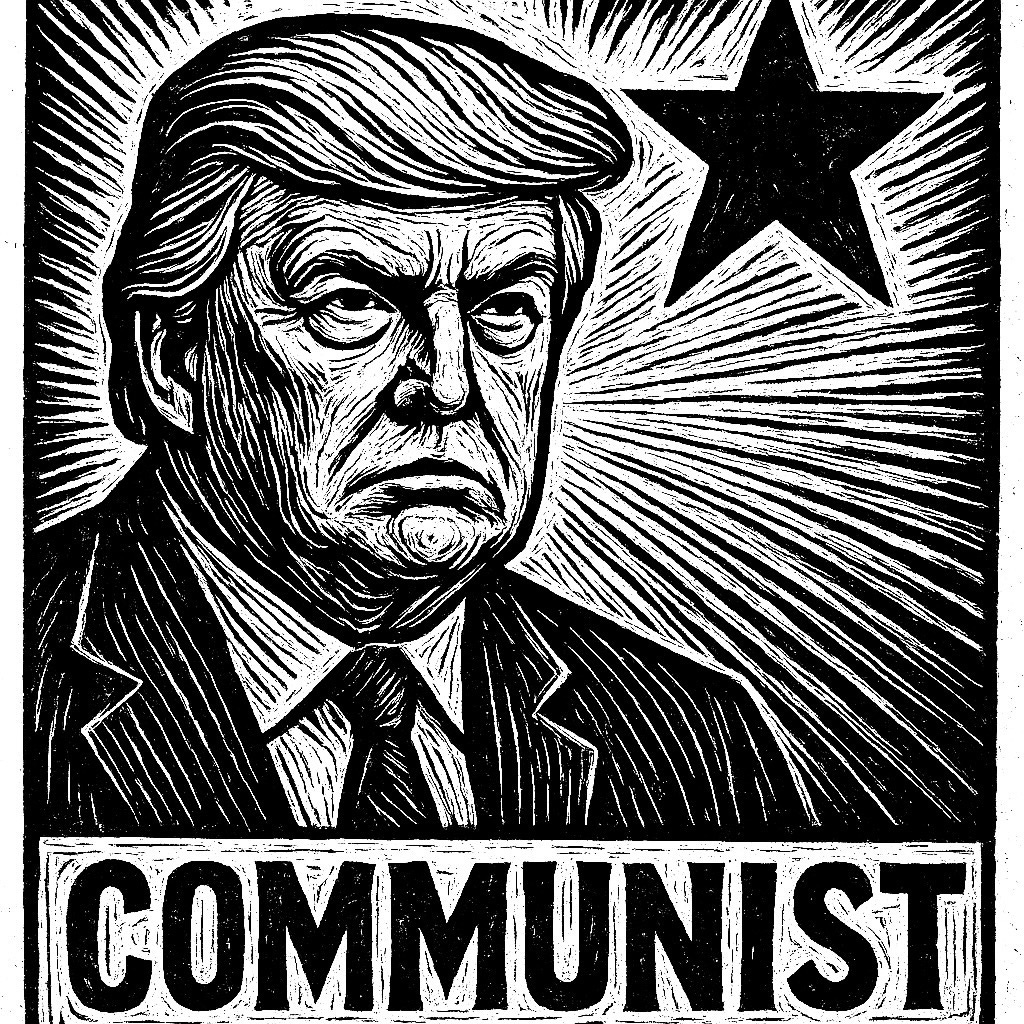
Friends abroad once looked to the United States as the antithesis of the Soviet Union, a place where liberty was real, where institutions restrained power, and where truth was not dictated by the state. Today many of those same friends describe America in the language they once reserved for Moscow. They speak of fear, of diminished freedom, and of a society where the leader brands critics as enemies and where institutions bend to the will of one man. The country that once stood as the measure of openness is now seen as unfree, and the reason is Donald Trump.
He presents himself as a capitalist and as a conservative, but when his politics are considered with any seriousness, they belong not to the American conservative tradition but to the lineage of communism as it was practiced in the twentieth century. Communism in its lived form was never the philosophy of liberation claimed by its proponents. It became the system of control in which the state consumed society, individuality disappeared into obedience, and loyalty to the leader became the measure of belonging. Trump’s instincts move along the same track. He denies limits, he treats institutions as instruments, and he demands a submission that resembles not democratic loyalty but the veneration once demanded of the Party leader.
Americans often call Trump a fascist, while his followers weaponize the word “communist” against their opponents. Both terms in this usage are insults, designed to disparage rather than to describe. But in Trump’s politics we see what history already showed us: the red–brown convergence. The fascists of the 1930s and the communists of the same era were not opposites but mirror images. Both demanded submission to the leader, both corrupted truth, both criminalized dissent, both fused the state with the person. Trump embodies that convergence. To call him fascist is not wrong, and to call him communist is not wrong, for in his practice they meet as one authoritarian form.
The irony is that he appeals to American conservatives by declaring himself one of them. The conservative tradition in the United States is defined by respect for limits, the authority of law above any individual, the continuity of institutions, the weight of precedent, and the conviction that freedom rests on restraint. Trump embodies the negation of each of these principles. His appeal works precisely because he has learned to speak the vocabulary of conservatism while stripping it of content. Those who believe they are defending conservatism in following him are in fact serving its destruction, for what he offers under that name is the very opposite, the concentration of power, the dismantling of checks, and the collapse of independence into the authority of a single man.
This dynamic is not foreign to history. Communism claimed to promise equality and delivered hierarchy. Behind the rhetoric of the people stood the nomenklatura, whose privileges and private wealth were hidden behind guarded walls. Trump follows this familiar pattern. He treats public office as a means of private enrichment, he surrounds himself with family as though power were inheritance, and he reduces access to governance into a transaction. The state is not a public trust but a resource to be harvested.
The language of rule also repeats itself. Stalin called critics enemies of the people, and on this foundation he built his machinery of purges and terror. Trump has adopted the same phrase and turned it against the press. To declare journalists the enemy is not a matter of rhetoric but of logic, for once the press is stripped of legitimacy, truth itself is destroyed. From there the ground is prepared for punishment, since those who are called enemies must be treated as such. Trump has made this explicit in his promise of retribution, and in his insistence that disagreement is betrayal. He has transformed difference into treason, which is the precise vocabulary by which communist regimes ruled their societies. The impulse extends beyond politics into culture itself. Comedians have become his targets, for even satire is treated as intolerable when it is directed against him. Companies that once defended creative freedom now bend to his will, censoring or silencing criticism out of fear. Russia under Putin followed the same path when it destroyed the satirical program Kukly, which had mocked political leaders until it was suppressed. The leader cannot be mocked in a system that makes the leader absolute, whether in Moscow or in Washington. Satire is critical in a democracy because it punctures the illusions of power, exposes hypocrisy, and reminds citizens that no leader is beyond question. The same logic now extends into American life, where even comedians like Colbert or Kimmel face threats for doing what satire is meant to do.
Communism maintained its grip through the corruption of truth. History was rewritten, facts were silenced, and reality was reduced to the declarations of the leader. Trump rules in the same corrupted atmosphere where truth is subordinated to power. He denies what is visible, he floods the public with falsehoods until truth itself appears unstable, and he instructs his followers to accept only his version of reality. The result is not persuasion but the destruction of the common ground upon which politics can rest. His appeal to religion belongs to the same pattern. He presents himself as a Christian defender of family values, yet his understanding of Christianity is as hollow as Stalin’s embrace of the Russian Orthodox Church, which he elevated only when it served the survival of his regime. In fact, the Russian Orthodox Church has been, across tsarist, Soviet, and post-Soviet times, one of the most significant instruments of control and abuse of people. Trump follows that model, using the symbols of faith not to sustain morality or community but to consolidate obedience and bend religion into an ornament of power. And to sell Bibles.
What makes his politics most dangerous is his stated desire to bring the whole of the state into his control. Communism permitted no independence, drawing courts, armies, churches, and universities into the Party. Trump has shown the same ambition: bringing the Department of Justice under his direct command, threatening to use the military for his personal purposes, and wielding economic power as an instrument of reward and punishment. In his conception nothing stands apart. What in a democracy is meant to restrain power becomes in his hands an extension of his will.
That his sympathies lie with Moscow is not an accident. Russia may have abandoned the communist banner in 1991, but it preserved the system’s essence, authoritarian rule, corruption as a method of governance, and imperial ambition as the foundation of foreign policy. The continuity runs deeper still. The Russian Empire before 1917 governed with the conviction that society existed only to serve the state and that opposition was treason. That autocracy provided the fertile ground upon which Bolshevik ideology could take root, for Lenin and his followers simply replaced the person of the czar with the person of the Party and claimed that despotism in the name of the people was progress. The Soviet Union perfected these habits with modern instruments of terror, and post-Soviet Russia under Putin has restored them once again, dressing them in new language but retaining the same structure of power. Trump praises this system, excuses it, and orients American policy toward it. His affinities are clear, and they make plain why he is best understood as a communist himself, for his politics mirror the same obsession with control, the same contempt for truth, and the same reduction of freedom to loyalty that have defined Moscow’s rule across empire, communism, and post-communism alike.
Friends abroad once recognized America as the alternative to Moscow. If Trump’s project prevails, they will see only the repetition of Moscow’s history, and America will have abandoned the very freedom it once defined.
Outstanding analysis. Your fusion of current events, history and political science is flawless.